
Top search terms
China's Electronic Spectrum Warfare Theories, Force Structure and Capabilities
2022-08-15
Over the past two decades, through military-civilian integration, industrial espionage activities and substantial research and development investment, the Chinese People's Liberation Army (PLA) has greatly enhanced its capabilities to conduct operations in and gain control over the electromagnetic spectrum. While the PLA's electromagnetic spectrum capabilities cover all offensive and defensive operations, its most advanced concepts and systems are designed to leverage China's home-field advantage in most potential conflicts, with the United States military identified as the primary adversary. By the integrated deployment of passive and multi-base sensing, wired communications and dedicated electronic warfare systems, the PLA seeks to disrupt the U.S. Department of Defense's system-of-systems and gain an edge in future conflicts.
China's Electronic Spectrum Warfare Strategy and Operational Concepts
The PLA adheres to the theory that the nature of warfare is evolving, and information has become the dominant factor of military power. According to the PLA's concept of informationized warfare, conflicts between the operational systems of both sides take place in a non-linear manner across the land, maritime, aerial, space, cyber, electromagnetic and psychological domains, with the objective of neutralizing the functions of the enemy's systems. Therefore, PLA forces plan to target the adversary's information flow to gain an advantage in system-vs-system confrontation.
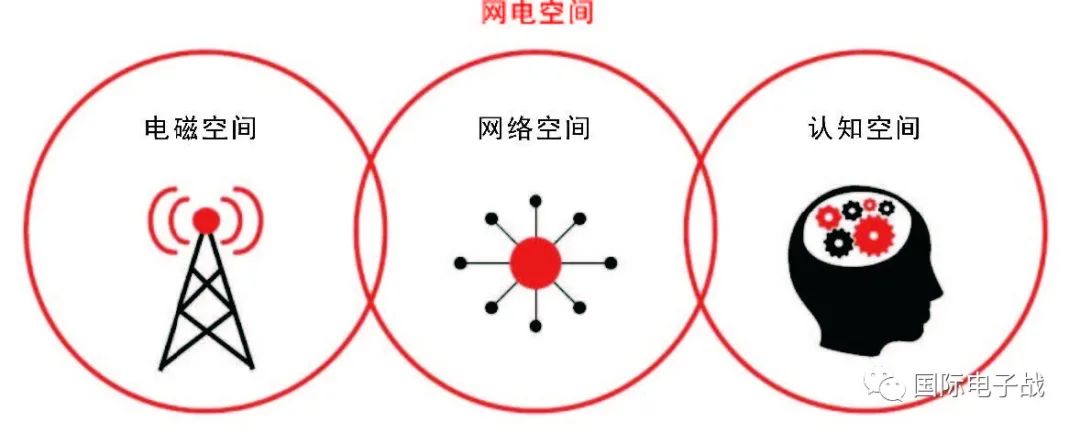
In the PLA's theoretical framework, the information environment encompasses the electromagnetic spectrum, cyberspace and the psychological domain.
To unleash the power of information, the PLA has developed new strategies and concepts for warfare in the unified cyber-electromagnetic space. Electronic warfare experts at the College of Electronic Countermeasures of the National University of Defense Technology of China pointed out in their authoritative strategic work The Winning Mechanisms of Electronic Countermeasures that the spectrum serves as the primary information carrier across all domains, and its importance cannot be overemphasized. The conclusion drawn in The Winning Mechanisms of Electronic Countermeasures is that whoever controls the electromagnetic spectrum holds the potential for a decisive advantage in conflicts. It also outlines four steps to achieve electromagnetic spectrum superiority:
- Concentrate Superiority to Shape the Operational Environment
Clarify the forces, systems and operational methods required for the PLA to leverage its own strengths and exploit the enemy's weaknesses. This phase relies on accurate intelligence and a comprehensive grasp of the adversary's capabilities, enabling targeted countermeasures against each of the enemy's operational systems.
- Integrate Multiple Sources to Generate Intelligence Support
Provide timely intelligence for PLA forces by integrating radar, electro-optical/infrared and electronic intelligence (ELINT) sensors deployed on land, sea, air and space platforms or systems, thereby guiding the decision-making of commanders and operators in joint operations. To achieve information fusion, the PLA's intelligence information support systems and those used for surveillance, reconnaissance, communications, navigation, positioning and guidance must be hardened and protected against enemy electronic and physical attacks.
- Precisely Deliver Effects to Disrupt Key Nodes
Strike critical nodes in the enemy's network at the outset of operational activities. The key nodes whose neutralization can disable the enemy's operational systems vary depending on the adversary, but they can be categorized into five functional types: reconnaissance and early warning, wireless communications, guidance and fire control, navigation and positioning, and identification friend or foe (IFF). The Winning Mechanisms of Electronic Countermeasures notes that destroying 10% of critical nodes is sufficient to disrupt the enemy's information network, whereas degrading even 40% of ordinary nodes would still leave the network intact. This assertion helps explain why the PLA has made intensive efforts to study the U.S. military's information systems.
- Achieve Multi-Domain Effects to Deter Conflict Escalation
The PLA aims to deter modern militaries that rely on electronic equipment by demonstrating its advanced electromagnetic strike capabilities and the will to use them. Additionally, the PLA expects electromagnetic decoys and deception to exert a psychological impact on the enemy's decision-making processes.